Each month, Gas Compression Magazine is delivered to more than 14,000 global readers. Available in print, digital, and audio formats, Gas Compression Magazine provides in-depth reporting on the products, systems, technologies, and news that impact the global gas compression market. Advertising in Gas Compression Magazine and its associate newsletter and website is an effective way to reach the people who purchase, package, maintain, manufacture, and teach gas compression equipment and systems.
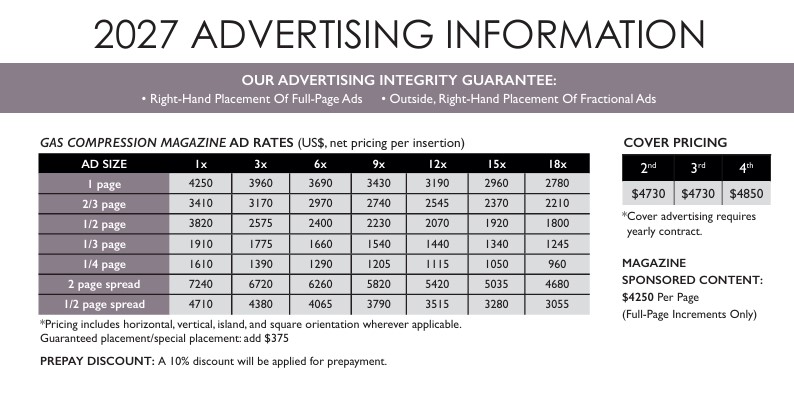
Our Advertising Integrity Guarantee:
• Right-hand Placement Of Full-Page Ads
• Outside, Right-hand Placement Of Fractional Ads
Print Delivers
- Gas Compression Magazine remains committed to offering free print subscriptions, allowing readers to choose their preferred delivery method — print, digital, or both — for free.
- Just how popular is print? We mail more than 8000 printed copies of Gas Compression Magazine per month — worldwide.
- We will continue to offer print delivery for free, as long as readers continue to request it.
- By continuing to offer print and digital subscriptions FOR FREE, more people see your messaging.
2027 Media Planner
Click Here To Download A PDF Of The 2027 Media Planner
2026 Media Planner
Click Here To Download A PDF Of The 2026 Media Planner
Print, Digital, And Audio
Gas Compression Magazine offers a complete portfolio of print, digital, and audio offerings to deliver your messaging to the people who are activity looking for information on gas compression products, systems, and services.
Click Here To Download Our Complete Portfolio Of Products & Services
2026 Gas Compression Magazine Featured Editorial
To become an exclusive sponsor of one or more of the 2026 featured editorial opportunities, please contact Sarah Gonzalez at: [email protected] or 832.271.7300, ext. 702
Mergers & Markets Review (January)
The Mergers & Markets 2025 Review discusses the biggest industry shakeups from the previous calendar year. It dives into specific deals and data and why they matter. The Review also provides context for understanding how 2025’s mergers and acquisitions activity compares to prior years, and how the dealmaking impacts the broader oil and gas industry. Click here to see last year’s report.
ESG Quarterly Callout (February, May, August, November)
ESG Quarterly Callout discusses the strategies, technologies, and investments that companies are making to create sustainability over the long term. It focuses on the environmental impact of the products, systems, and technologies that affect the global gas compression industry. The content is similar to a standard featured editorial, but it tells the story through an environmentally focused lens, helping readers keep their finger on the pulse of the energy transition. Click here to see previous ESG Quarterly Callout featurettes.
Compressor Startup Report (March)
The Compressor Startup Report includes information gathered from the US Federal Energy Regulatory Commission (FERC) records and other global agencies. It shows the compressor units that received government approval to be placed into service in the year prior. The report includes project names, facilities, operators, location, type (electric motor, reciprocating engine, or gas turbine), the prime mover, including the original equipment manufacturer (OEM), model number, horsepower, type (centrifugal or reciprocating), and the compressor OEM. Click here to see last year’s report.
LNG Race Report (April)
The LNG Race Report may provide a data-driven overview of the state of global liquefied natural gas (LNG) exports and imports, or it could take a deep dive into a specific project update that is reshaping the industry. The report is especially useful for industry participants looking for insight into project statuses, policy and regulation affecting the LNG market, and technologies that are changing the way LNG projects go from ideas, to achieving a final investment decision, to booking contracts and reaching first cargo. Click here to see last year’s report.
Executive Outlook (June)
The Executive Outlook features conversations with executives across the gas compression industry. Participants discuss the role their business plays in the gas compression industry, the biggest challenges facing the industry, products, services, projects the company is bringing to market that would involve or impact gas compression, geographical regions that are driving industry growth, market indicators, industry trends and opportunities, and expectations for where the industry will be in the next five to 10 years.
The Executives Outlook may feature a blend of industrial conglomerates, original equipment manufacturers, project developers, packagers, components and parts manufacturers, distributors, and even up-and-coming companies that are pushing the boundaries of what is possible in the industry. Click here to see last year’s Executive Outlook.
Class Of 2026 (July)
Among the greatest challenges facing the gas compression industry today is a shortage of qualified technicians. The aging workforce is not being bolstered by newcomers. As the pace of retirement quickens, so does the among of industry knowledge that is being lost. Gas Compression Magazine reaches out to colleges that offer curricula that targets the natural gas industry. It presents data on these programs, including compression program offerings, types of courses offered, class size, and how to get in contact with these programs. It also features the compressors, drivers, and other equipment that is used for hands-on learning, internships available for students. Click here to see last year’s report.
Forecast For Compression (September)
The Forecast For Compression discusses natural gas and crude oil key metrics, such as pricing, inventory levels, supply, and demand. It features commentary from executives across the oil and gas industry, including opportunities, challenges, new product technologies to drive growth, and more. The forecast discusses liquefied natural gas (LNG) and oil and gas production and export expectations and may even cover low carbon fuels like renewable natural gas and hydrogen. Click here to see last year’s forecast.
2026 Capex Comparison (September)
The Capex Comparison data set is compiled using publicly available information from company filings (10-Ks, 10-Qs), investor presentations, earnings call transcripts, and reputable financial data platforms. The report discusses capital expenditure (capex) spending plans for over 65 companies that heavily influence the gas compression industry. In addition to covering historical and near-term capital expenditure data, the report also features analysis of capex spending, include capex rationale, primary capex uses, major projects, and other capital commitments. The report is a useful tool for industry participants or watchers looking to connect the dots presented by financial data to see where the industry stands and where it could be headed. Click here to see last year’s report.
Pipeline Report (October)
Pipelines are the circulatory system of the oil and gas industry. Without them, the entire sector would grind to a halt. The 2026 Pipeline Report may take a deep dive into major pipeline projects that are moving large quantities of natural gas across the continent, or it may focus on the compressor stations along the way. The 2026 Pipeline Report may also cover the data provided by pipelines. Pipelines are also data-rich assets. Their insights reveal capex priorities, regional bottlenecks, and strategic positioning. Tracking pipeline expansions and utilization rates offers insight into production forecasts, refinery throughput and margin capture, and what’s driving the industry and energy transition, such as oil and natural gas pipelines versus hydrogen projects. Click here to see a previous report.
2026 Reader Survey (December)
Each year, Gas Compression Magazine presents a short questionnaire designed to provide a snapshot of the global compression industry. The survey is posted on https://gascompressionmagazine.com/ for two weeks in November, shared with our global readership via direct email, and presented to industry groups on LinkedIn and Facebook. Participants represent the entire value stream (upstream, midstream, and downstream) and hold positions in all job categories within the gas compression industry (operational, technical, professional, supervisory, managerial, etc.). Click here to see last year’s survey results.
Podcasts
Available wherever you listen to podcasts, Gas Compression Magazine produces two podcasts. Published monthly, each show has a maximum of three sponsors per episode OR one exclusive sponsor. Your 15-second message (@150 words) is read by the podcast host.
GCM On The Go
A digital reading of the feature articles found in the latest issue of Gas Compression Magazine.
The Gas Compression Podcast
Conversations with leaders and practitioners in the gas compression industry.
Clicker Here To Download Our Podcasts Media Planner
Click Here To Download Our Ad Size Requirements & Specifications
To advertise in Gas Compression Magazine, contact Sarah Gonzalez at: [email protected] or 832.271.7300, ext. 702
Frequently Asked Questions
I’ve seen other publications stack half-page ads on top of each other on the same page. Do you?
No. We place a single, half-page ad on a page. We do not stack half-page ads on the same page.
Some publications place fractional ads on the left side of the page, near the spine of the magazine, making them difficult to notice. Do you do that?
No. Fractional ads are placed on the outside, right-hand side of a page.
Is there a different rate based on the orientation of my fractional ad?
No. All rates are the same based on ad size. There is no additional charge for island ads or vertical or horizontal positioning.
If I’m booking multiple ads, will I be billed for everything at once?
Each issue is billed after it is mailed. You pay for each ad after it has run in the magazine. If you would prefer to prepay or make one payment for the entire ad program, we are happy to arrange that.
I need help creating my ad from scratch or adjusting an ad I have. Can you help?
Of course! Our in-house design team can help with your ad at no charge.
Do you offer agency discounted rates?
No. We set out to redefine publishing and simplify advertising. Our prices are NET. What you see is what you pay.
I see that there are different rates for the same size ad listed in the media planner. How do I get the lowest rate?
Ad rates are based on frequency. The more issues advertise in, the lower the rate is for each ad.
Does my ad appear in both the print and digital version of the magazine?
Yes. Gas Compression Magazine is offered in print and digital formats. Your ad will be appear in each.

Gas Compression Magazine en Español is the ONLY Spanish-language magazine devoted to gas compression products, systems, technologies, and news.
Download the Gas Compression Magazine en Español media planner here.