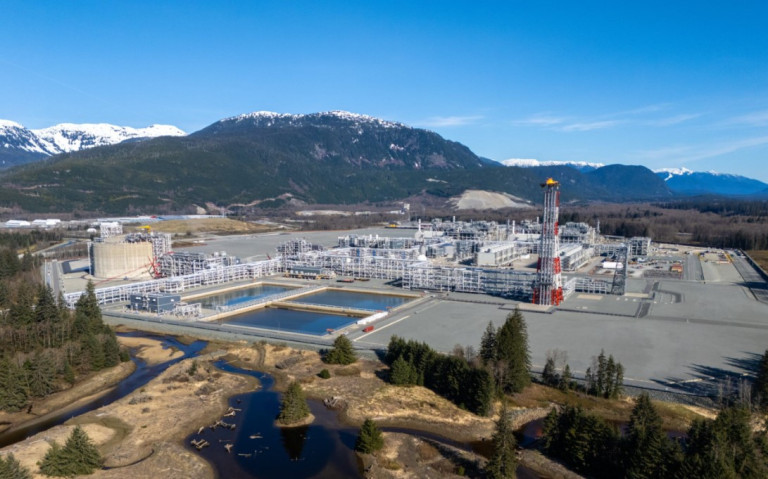
Fluor Corp. and JGC Corp., operating through their 50/50 joint venture (JV), have received a limited notice to proceed for the proposed Phase 2 expansion of the LNG Canada export facility in Kitimat, British Columbia. Under the authorized funding agreement, the contractors will immediately advance early engineering, project planning, and the procurement of long-lead materials ahead of a potential final investment decision (FID) expected by the end of 2026.
The JV partners previously served as the engineering, procurement, fabrication, construction, and commissioning contractor for Phase 1 of the project. Completed in the summer of 2025, Phase 1 successfully delivered the site’s baseline infrastructure, including a 59 million gallon (225,000 m3) full-containment liquefied natural gas (LNG) storage tank, a dedicated water treatment facility using a closed-loop recycling system, a rail yard for condensate handling, 197 ft. (60 m) and 410 ft. (125 m) dual flare stacks, and a marine terminal featuring an upgraded wharf capable of berthing two specialized LNG carrier ships simultaneously. Phase 1 introduced the facility’s first two 7 MTPA trains, bringing the total export capacity to 14 MTPA. Driven by four 100-MW GE Vernova LMS100 gas turbines, each train uses two specialized refrigeration compression modules, each equipped with a matching Baker Hughes centrifugal compressor, to chill and liquefy approximately 1.84 bcf/d (52.1 x 10⁶ m3/d).
If a positive FID is achieved, the Phase 2 expansion will add two additional liquefaction trains, effectively doubling the facility’s total output to 28 MTPA. To support this growth, LNG Canada and the operators of the Coastal GasLink pipeline have formalized a joint agreement to expand pipeline capacity, ensuring the necessary natural gas feedstock can reach the expanded Kitimat terminal. The progression of Phase 2 plays a pivotal role in Canada’s broader energy strategy to diversify its dependence on the US market. While current projects in development are expected to push Canada’s total export capacity to roughly 19 MTPA by 2030, the addition of LNG Canada Phase 2 alongside other advanced Pacific Coast proposals, such as the Nisga’a Nation’s 12 MTPA Ksi Lisims LNG project, could elevate Canada’s total export capacity to approximately 45 MTPA by the early 2030s.
LNG Canada operates under an amended long-term export license from the Canada Energy Regulator, which extends the maximum export timeline from 40 to 50 years to provide long-term financial certainty for participants. The project’s underlying assets remain divided between two distinct corporate structures. The LNG Canada asset consortium is comprised of Shell (40%), Petronas (25%), PetroChina (15%), Mitsubishi Corp. (15%), and Kogas (5%), while the project’s primary engineering and construction contractor, JFJV2, is a Canadian joint venture held equally by Fluor and JGC.