The long-anticipated Alaska LNG Project has taken a major step towards a final investment decision (FID), with the developer Glenfarne Alaska LNG LLC (Glenfarne) announcing a major equipment and investment deal with Baker Hughes.
The Alaska LNG Project aims to commercialize the vast natural gas resources of Alaska’s North Slope by building an 807-mile (1298 km), 42-in. (106 cm) diameter pipeline to transport natural gas to meet Alaska’s domestic energy needs and constructing a large-scale liquefaction and export terminal on Alaska’s Kenai Peninsula to serve Asian markets.
Glenfarne, which holds a 75% stake in the project alongside the state-owned Alaska Gasline Development Corp., is utilizing a two-phase development strategy for the US$40+ billion project.
Phase 1 focuses on the pipeline to bring gas to in-state customers. Phase 1 FID is expected in December. Pipeline construction will then begin in 2026 with an operational target of 2029.
Phase 2 involves the construction of the Nikiski liquefaction facility and export terminal, with that FID projected for late 2026. Commercial LNG exports are targeted to begin by 2031.
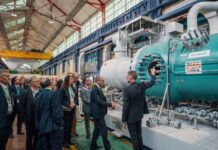
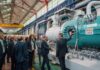
Baker Hughes will supply critical equipment for the project, including main refrigerant compressors for the liquefaction terminal in Nikiski, as well as power generation equipment for the new gas treatment plant near Alaska’s Prudhoe Bay and Point Thomson fields
The liquefaction facility will process, store, and transport LNG using the Propane Precooled Mixed Refrigerant Process, an Air Products patented technology. In this process, the treated natural gas would first be pre-cooled in successive stages of propane chilling. Subsequent cooling and liquefaction would be achieved by heat exchange against mixed refrigerant and would be accomplished in the main cryogenic heat exchanger (MCHE). Prior to entering the MCHE, the mixed refrigerant would be pre-cooled/partially condensed. The refrigeration for this pre-cooling would also be provided by multiple stages of propane chilling.
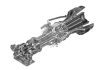
The facility will include three LNG trains. Each train will include two refrigerant compression strings installed in parallel, driven by two natural gas turbines. Total capacity of natural gas turbines driving refrigeration compressors for all trains is approximately 800,000 hp (596,800 kW).
All boil off gas (BOG) generated from the LNG lines, LNG loading pumps, and storage tanks, plus vapor return from LNG loading operations, will be compressed and routed to the fuel gas system. BOG generated in excess of fuel gas demand will be recycled to the natural gas stream entering the liquefaction process. BOG from the LNG storage tanks and loading berths will provide the majority of the overall plant fuel needs for operations.
LNG from the three liquefaction trains will be stored in two LNG storage tanks. Each tank can store approximately 54.4 million gallons (240,000 m3). The LNG storage tanks, capable of storing 108.9 million gallons (480,000 m3) total, will provide a storage capacity of three to four days of production.
To date, Glenfarne has secured preliminary commercial commitments with leading LNG buyers in Japan, Korea, Taiwan, and Thailand for 11 MPTA of LNG, more than 60% of the volume needed to reach FID, including recent agreements with Tokyo Gas, JERA Co. Inc., and POSCO International Corp.