By Jose Villar, Andrew Iraola
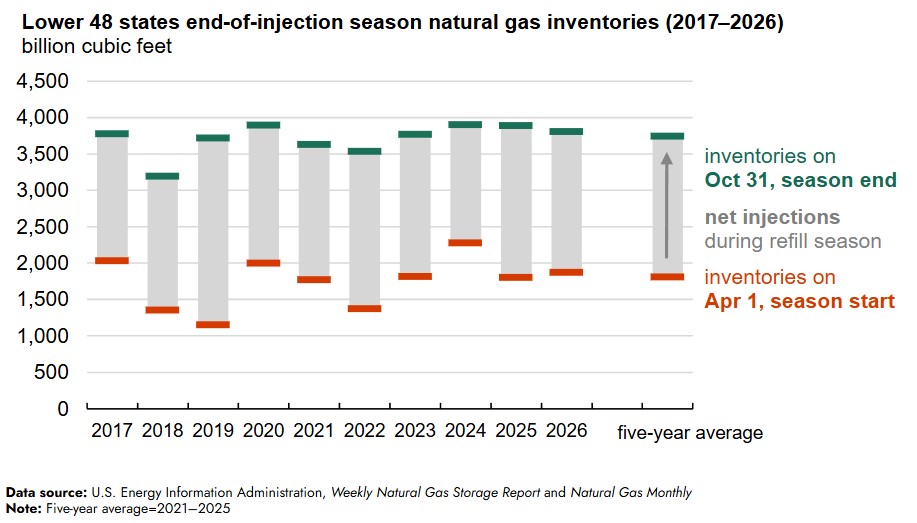
Working natural gas in storage in the Lower 48 states ended the natural gas injection season at 3.8 tcf (1.07 x 10¹¹ m3), exceeding the five-year average by almost 2%, according to estimates based on data from the US Energy Information Administration’s (EIA’s) November 12 Weekly Natural Gas Storage Report. Injection season runs April 1 through October 31, the months of typically lower natural gas demand.
While net injections were 2 bcf (56.6 x 10⁶ m3) less than the five-year average this injection season, working gas stocks are higher than usual because they started the 2026 season 3% (63 bcf) above the five-year average at 1.8 tcf (50.9 x 10⁹ m3).
Higher than average inventories at the start of the summer injection season allowed storage operators to reach their end-of-season targets with smaller incremental natural gas injections. Although total dry natural gas production during the 2026 refill season was 3% higher than the same period in 2025, according to S&P Global Energy, most of the increased production during this period was used to meet rising demand from liquefied natural gas export terminals.
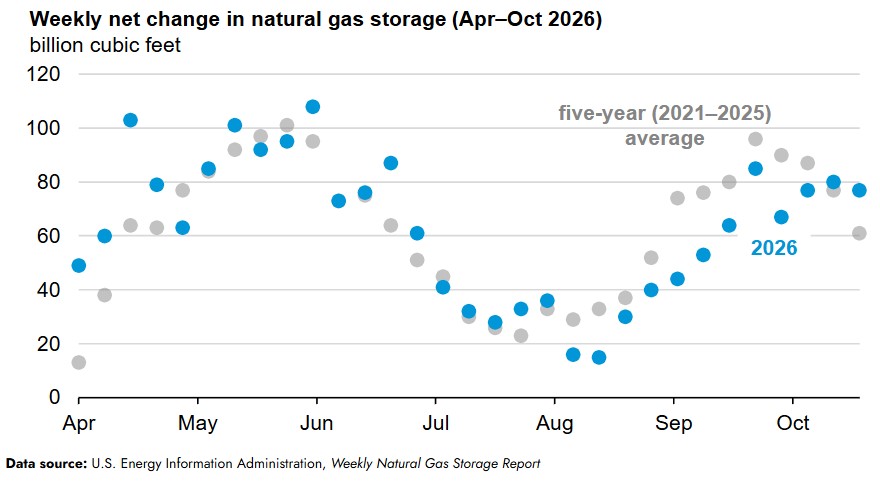
Mild spring temperatures during the first several weeks of the refill season mitigated seasonal residential and commercial natural gas demand, allowing the surplus to the five-year average to grow, peaking at 198 bcf (5.6 x 10⁹ m3) (7%) for the week ending August 7, before declining for the next 10 consecutive weeks, as warmer-than-normal temperatures during the summer months increased power generation demand for natural gas. Mild temperatures returned during the final weeks of the injection season, which led to above-normal injections. Weekly injections ranged from 108 bcf (3.05 x 10⁹ m3) in early June to 15 bcf (424.7 x 10⁶ m3) in late August.
In its November Short-Term Energy Outlook, the EIA forecast natural gas withdrawals during the 2026–2027 heating season (November 1–March 31) will total 1.9 tcf (53.8 x 10⁹ m3) and that inventories will be 4% above the five-year (2022–2026) average at the end of March 2027 because of a relatively mild winter and increases in natural gas production.
About The Authors
Jose Villar and Andrew Iraola are research analysts with the US Energy Information Administration.