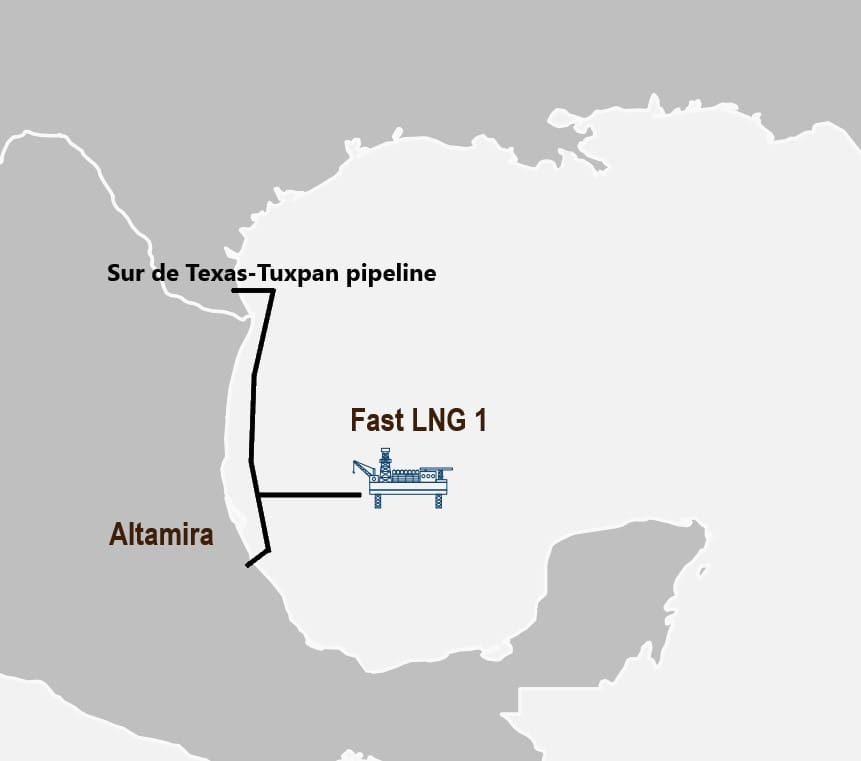
New Fortress Energy Inc. (NFE) has achieved first liquefied natural gas (LNG) for its initial Fast LNG asset located offshore Altamira, Mexico. NFE’s proprietary Fast LNG design pairs modular liquefaction technology with jack up rigs or similar offshore infrastructure to enable a faster deployment schedule than traditional liquefaction facilities. Three units – Poineer I, Pioneer II, and Pioneer III – complete NFE’s Fast LNG 1. Production capacity is 1.4 MTPA, using gas from the offshore Sur de Texas-Tuxpan pipeline.
The liquefaction module utilizes a Baker Hughes LM6000PF+ gas turbine-driven compressor, Chart Industries’ (Chart) Integrated Pre-Cooled Single Mixed Refrigerant (IPSMR) process technology, air coolers, and hose reels to transport the newly made LNG to the floating storage unit to await sale into the market.
“We are proud to support NFE and the industry with our modular liquefaction technology and all mission critical equipment, including brazed aluminum heat exchangers, cold boxes and air coolers,” said Jill Evanko, president and CEO of Chart. “We congratulate NFE for this success of first LNG, and we look forward to further supporting the industry with our modular, adaptable, resilient and cost-effective technology and products.”
Chart’s IPSMR process technology, proprietary braised aluminum heat exchangers, and cold boxes are integral elements of Fast LNG process. IPSMR process technology can be configured to match available gas turbine power with single cold box capacity to 3 MTPA. Each liquefaction train is paired with a heavy hydrocarbon removal system (HHC) to remove freezing components from the feed gas before liquefaction. The HHC comprises a scrub column, braised aluminum feed gas exchanger, and reflux drum in a fully assembled cold box module.
Three Siemens SGT 400 gas turbines provide power for the systems required to support the 80-team member living quarters, utilities, and helideck of the Fast LNG 1 project.

How Fast LNG Works
Modules Are Fabricated: Standardized modules for liquefaction, gas treatment, and utilities are fabricated at the shipyard and assembled near their installation location to minimize transportation time and risk of damage.
Modules & Major Equipment Are Installed: Modules and major equipment such as the cold box, mixed refrigerant compressors, and gas turbines are installed on platforms at shipyard. There are three platforms total per Fast LNG unit: one each for liquefaction, gas treatment, and utilities.
Platforms Are Transported & Installed: Platforms are transported from the shipyard to their designated offshore location. Platforms are installed offshore and connected with bridges.
FSU Is Connected: The Facility is connected to a floating storage unit (FSU) via a cryogenic flexible hose system. FSU stores LNG for transloading to LNG tankers.
Natural Gas Supply Is Connected: Natural gas is supplied to the facility via hot tap into a series of offshore wells, a gathering system, or subsea pipeline. In this case, NFE’s FLNG 1 is hot tapped into the offshore Sur de Texas-Tuxpan pipeline.
LNG Is Produced & Shipped: Natural gas is processed by the gas treatment module, then liquefied by the liquefaction module. When ready for shipment, LNG is transferred from the FSU to an LNG tanker via flexible hose. LNG is then shipped to various markets around the world.
“We are immensely proud of the dedication and hard work by our team, who have completed more than 9 million work hours, to bring this large-scale project to life at a record pace,” said Chris Guinta, chief financial officer at NFE. “In doing so, our downstream customers now benefit from additional access to clean and reliable LNG, enabling sustained growth well into the future.”