Eastern Gas Transmission and Storage Inc. (EGTS) has filed an application with US Federal Energy Regulatory Commission for its Appalachian Reliability Project in Pennsylvania and Ohio. EGTS proposes to construct 3.9 miles (6.2 km) of 30-inch (76.2-cm) diameter pipeline; install additional compression at three existing compressor stations; and construct a new metering and regulation station and modify two existing metering and regulation stations.
The project will create an additional 550,000 Dt/d of transportation capacity. This firm transportation service will originate from existing and new receipt points in Armstrong County, Pennsylvania, and other locations on EGTS’ system, with deliveries directed to the TETCO pipeline in Westmoreland County, Pennsylvania, and the REX pipeline in Monroe County, Ohio. The project utilizes targeted enhancements to existing natural gas infrastructure to provide incremental firm transportation service in a market region that currently lacks capacity on peak days. The project will expand access to natural gas to meet home heating, commercial, and industrial uses in Pennsylvania, Ohio, West Virginia, and markets in the Midwest, Northeast and Mid-Atlantic.
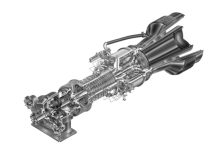
JB Tonkin Compressor Station currently has one natural gas-driven reciprocating engine, which provides 6000 hp (4476 kW) of compression and is capable of compressing gas in multiple directions. The proposed modifications at this compressor station will include the addition of one 20,500 hp (15,293 kW) Solar Titan 130 turbine (Unit 2) coupled to a C453-LHS centrifugal compressor and associated auxiliary systems including a catalyst system, air intake, exhaust system, fuel gas system, dry seal gas recompression system, instrument air system, lube oil system, vent systems, and drain systems. The project includes installation of hydrocarbon and accumulator tanks, gas cooler, suction filter/separator, unit/suction/discharge blowdown silencers, measurement and regulation devices, utility gas system, main gas piping/valves/operators/fittings, and electrical systems required for all devices. The proposed compression and ancillary equipment will be capable of compressing gas in multiple directions among the connecting pipelines at the station, as do the existing facilities.
Crayne Compressor Station currently has four natural gas-driven turbines, two of which provide 7800 hp (5818 kW) of compression and two of which provides 7700 hp (5744 kW), for a combined total of 31,000 hp (23,126 kW) of compression. The four turbines are capable of compressing gas in multiple directions. The proposed include upgrading the capacity on units 1 & 2 discharge crossover flow control valves to accommodate 514,000 Dt/d. The proposed ancillary equipment will be capable of compressing gas in multiple directions among the connecting pipelines at the station, as do the existing facilities.
Mullett Compressor Station currently has three natural gas-driven reciprocating engines; two of which provide 5000 hp (3730 kW) of compression and one of which provides 3550 hp (2648 kW), for a combined total of 13,550 hp (10,108 kW) of compression. The proposed modifications at the existing Mullett Compressor Station include expansion of the facility fence line to accommodate the addition of one new 11,110 hp (8288 kW) gas-fueled turbine unit with discharge cooler, intake, exhaust, and lube cooler. The modifications will also include one new compressor building, one new auxiliary/MCC building, one new utility building, one new backup generator, and the replacement of the existing storage building where the new compressor building will be installed with a new storage building. Installation of a suction filter/separator, discharge/filter separator, unit blowdown silencer, main gas piping/valves/operators/fittings, and electrical systems required for all devices will also be required to operate the new turbine unit (Unit 4). The proposed compression and ancillary equipment for Unit 4 will be capable of compressing gas to multiple pipelines that currently interconnect with the station, as do the existing compression facilities.