By Andrew Iraola
The US Energy Information Administration (EIA) estimates the Lower 48 US states began this natural gas injection season (April thru October) with 1.89 tcf (53.5 x 10⁹ m3) of working natural gas in storage, based on interpolated data from its Weekly Natural Gas Storage Report. This level was 3% above the previous five-year (2021 thru 2025) average and 3% above last year’s end-of-season storage volume.
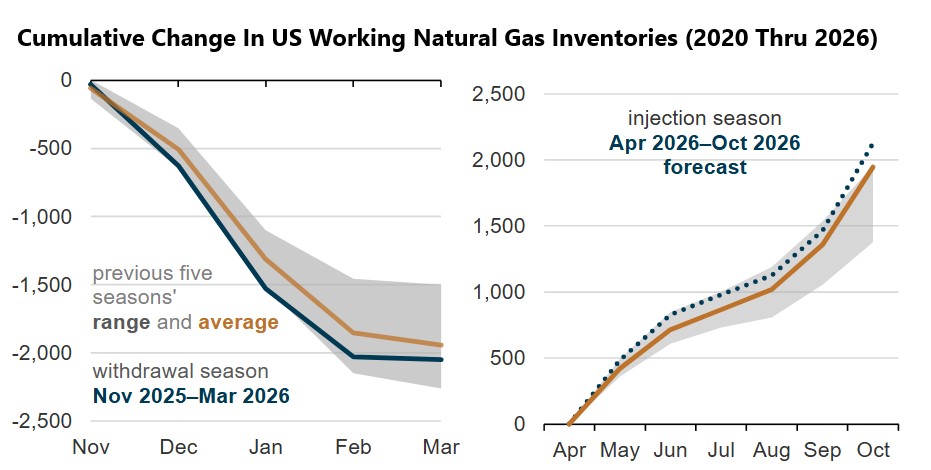
After a relatively warm start to the 2025–26 winter heating season (November thru March), colder-than-normal temperatures across much of the United States in January, including Winter Storm Fern, resulted in a record storage withdrawal of 360 bcf (10.19 x 10⁹ m3) for the week ending January 30. Natural gas inventories fell to 5.6% below the previous five-year average in subsequent weeks. However, slower withdrawals due to milder weather in February and March brought inventories back above this threshold. By the week ending March 13, storage levels were 2.6% above the five-year average, and by April 3, they were 4.8% above the average.
US natural gas consumption typically peaks during the winter heating season, when colder temperatures increase demand for space heating in the residential and commercial sectors. Reduced natural gas consumption in these sectors has helped moderate prices since January. Consumption in February and March averaged 42.2 bcf/d (1.19 x 10⁹ m3/d) and 26 bcf/d (736.2 x 10⁶ m3/d), respectively, down from 51.9 bcf/d (1.4 x 10⁹ m3/d) in January, according to LSEG Data. Henry Hub averaged US$3.04 dollars per MMBtu) in March, down from US$7.72/MMBtu in January and US$3.62/MMBtu in February.
Data Source: US Energy Information Administration, Short-Term Energy Outlook, April 2026, and Weekly Natural Gas Storage Report
Net withdrawals from natural gas storage during the season totaled 2.048 tcf (57.9 x 10⁹ m3), 5% more than the five-year average. Weekly withdrawals ranged from a minimum of 11 bcf (311.4 x 10⁶ m3) in mid-November to a maximum of 360 bcf in late January.
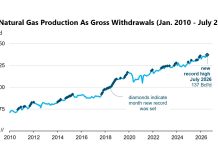
The EIA expects natural gas injections to exceed the five-year average this injection season, supported by record dry natural gas production. According to the EIA’s latest Short Term Energy Outlook, it expects net injections into natural gas storage facilities this season will reach 2.125 tcf (60.17 x 10⁹ m3), 9% more than the five-year average.
The EIA projects the increase in natural gas production will exceed the combined growth in electric power summer demand and year-round LNG exports, enabling more gas to be injected into storage.
About The Author
Andrew Iraola is a research analyst for the US Energy Information Administration.