By Victoria Zaretskaya
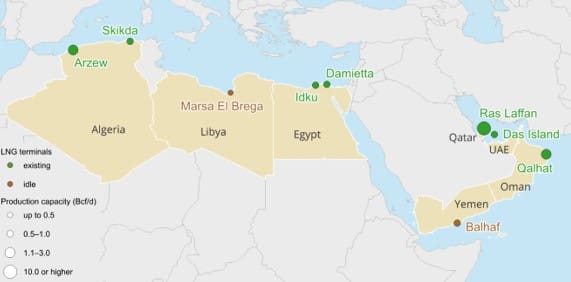
Exporting countries in the Middle East and North Africa region (MENA) supplied nearly one-third (29%) of global liquefied natural gas (LNG) exports in 2022, according to data from the International Group of Liquefied Natural Gas Importers (GIIGNL). GIIGNL is a non-profit organization whose objective is to promote the development of activities related to LNG: purchasing, importing, processing, transportation, handling, re-gasification and its various uses. The share of global LNG exports coming from the region’s exporters—Qatar, Oman, the United Arab Emirates (UAE), Algeria, and Egypt—declined from 47% in 2013 to about 30% by 2020 because of growing LNG exports from Australia and the United States.

Qatar exports more LNG than any other country in MENA, accounting for a 70% regional share in 2022. Globally, Qatar is one of the three largest LNG exporters, averaging 10.3 Bcf/d during the last 10 years. Oman and the UAE are the second- and third-largest LNG exporters in the Middle East, respectively. Oman started exporting LNG in 2000, and its exports have consistently averaged 1.2 Bcf/d during the last decade. LNG exports from the UAE’s emirate of Abu Dhabi started in 1977 and have averaged 0.7 Bcf/d during the last decade. LNG exports from Yemen started in 2010 and averaged 0.8 Bcf/d from 2011 to 2014, but they have been suspended since May 2015 following a military conflict.
In North Africa, only Algeria and Egypt export LNG. Algeria was one of the world’s first LNG exporters and has over 40 years of LNG export history. Algeria’s LNG exports have remained stable over the last 10 years, ranging from 1.3 Bcf/d to 1.7 Bcf/d.

Egypt exported 0.9 Bcf/d in both 2021 and 2022, although exports vary depending on the season. The volume of LNG exports is determined by domestic production, domestic demand, and regional production brought to Egypt via pipeline. In recent years, domestic natural gas consumption in Egypt has increased while production has declined, which contributed to Egypt suspending its LNG exports in 2015. Egypt imports natural gas from Israel via the East Mediterranean Gas (EMG) pipeline (up to 0.7 Bcf/d) and the Arab Gas Pipeline (AGP) (up to 0.2 Bcf/d). At the start of the Israeli-Hamas conflict in October, Israel suspended exports to Egypt via the EMG pipeline because of production stoppages at the offshore Tamar field, which supplies the EMG pipeline. Tamar field production has since been restarted.
Egypt’s LNG exports peak during the winter when domestic demand is low and Egypt can export surplus natural gas from its production and imports as LNG. During last winter, from November 2022 through March 2023, Egypt’s LNG exports averaged 2.0 Bcf/d, according to data from CEDIGAZ, an international not-for-profit organization created in 1961 by corporate and institutional members with a mandate to deliver accurate market data and analyses on natural gas, LNG and unconventional gas.
Most of the MENA region’s LNG exports are shipped to South Asia and East Asia, which received 65% (9.7 Bcf/d) of the region’s LNG exports in 2022. The share of MENA’s LNG exports going to South Asia and East Asia has remained fairly consistent over the past 10 years, varying between 60% and 70% of the total. MENA’s LNG exports to Europe, which fluctuate depending on European natural gas demand, have ranged from 3.5 Bcf/d to 4.8 Bcf/d during the past 10 years. In 2022, exports to Europe averaged 4.5 Bcf/d, 30% of total MENA LNG exports. Up to 4% of exports from MENA are sent to Kuwait and the UAE, specifically the emirate of Dubai.
About The Author
Victoria Zaretskaya is an analyst with the US Energy Information Administration.