By Naser Ameen
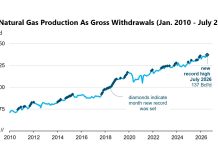
US marketed natural gas production reached a new record in 2025, growing by 5.3 bcf/d (150.07 x 10⁶ m3/d) to average 118.5 bcf/d (3.3 x 10⁹ m3/d), according to the US Energy Information’s (EIA’s) latest Natural Gas Monthly. Three regions — Appalachia, Permian, and Haynesville — accounted for 67% of the total marketed gas production in the United States in 2025 and for 81% of the growth last year.
The EIA’s Short-Term Energy Outlook breaks out US Lower 48 (L48) marketed natural gas production data for the Appalachia, Bakken, Eagle Ford, Haynesville, and Permian regions and also includes Alaska and Gulf of America production data. In 2025, Henry Hub spot prices rose by 60% to US$3.52 per MMBtu, which contributed to growth in all regions. The Appalachia, Permian, and Haynesville regions accounted for 4.2 bcf/d (118.9 x 10⁶ m3/d) growth while other regions accounted for the remaining 1.1 bcf/d (31.1 x 10⁶ m3/d) growth.
In 2025, more natural gas was produced in the Appalachia region of the Northeast than in any other US region, accounting for 31%, or 36.6 bcf/d (1.06 x 10⁹ m3/d), of marketed natural gas production. Production growth in the Appalachia region has been slowing in recent years because of limited pipeline takeaway capacity to transport natural gas to demand markets. On June 2024, the Federal Energy Regulatory Commission authorized the Mountain Valley Pipeline to begin operations. With this new capacity addition and the higher Henry Hub prices in 2025 relative to the previous year, production in the Appalachia grew by 1.1 bcf/d in 2025 compared with the increase of just 46 MMcf/d (1.3 x 10⁶ m3/d) in 2024.
The Permian region in Texas and New Mexico accounted for 23% of the marketed natural gas production in the United States in 2025 and around half the growth in US production. In 2025, marketed natural gas production in the Permian region rose by 11%, or 2.7 bcf/d (76.4 x 10⁶ m3/d), to average 27.7 bcf/d (784.3 x 10⁶ m3/d).
In the Permian region, growth in natural gas production is primarily the result of associated gas produced during oil production. West Texas Intermediate crude oil prices fell from US$77/b in 2024 to US$65/b in 2025. This price continued to support oil-directed drilling in the Permian region. Oil industry executives responding to the Dallas Fed Energy survey report the two largest basins in the Permian had breakeven prices of US$61/b (Midland Basin) and US$62/b (Delaware Basin) in 2025. Additionally, the average gas-to-oil ratio, which has been steadily increasing in the Permian, contributed to natural gas growth.

Data Source: US Energy Information Administration, Short-Term Energy Outlook, March 2026
Note: GOM = Gulf of Mexico, AK = Alaska, L48 = Lower 48 US States
In 2025, production in the Haynesville region, which spans Louisiana and Texas, averaged 14.9 bcf/d (421.9 x 10⁶ m3/d), 4% more than the 2024 annual average. The Henry Hub price increase from 2024 to 2025 allowed drilling in the Haynesville region to remain economical even with relatively deeper and more expensive well development costs. The Haynesville formation is between 10,500 and 13,500 ft (3200 and 4115 m) deep compared with wells that average 4000 to 8500 ft (1219 to 25590 m) deep in the Appalachia region. But the Haynesville’s proximity to liquefied natural gas export terminals and major industrial natural gas consumers along the US Gulf Coast draws operators to the region.
About The Author: Naser Ameen is a research analyst with the US Energy Information Administration.